
Short Answer
Venice, California offers one of the most varied housing menus on the Westside: canal-front homes in the historic canal district, compact bungalows lining the pedestrian-only walk streets, converted and purpose-built lofts near Abbot Kinney, single-family houses in the Silver Triangle and North Venice, and a mix of townhomes and duplexes throughout. The main trade-off is character and location versus flexibility: a canal home comes with historic-district and coastal-zone oversight, a walk-street bungalow trades car access for a quiet pedestrian setting, and a loft gives you open modern space but often less private outdoor room. Before you write an offer anywhere in Venice, the first verification step is the same regardless of pocket: confirm the property's coastal-zone status through the City of Los Angeles Venice Local Coastal Program and check its FEMA flood zone, because both directly affect what you can build, insure, and resell.
Because active inventory in a market this small changes weekly, the counts and price bands below should be confirmed against live MLS data before you rely on them. If you'd like a current pull for a specific pocket, that's a quick conversation.
What Kinds of Homes Are for Sale in Venice, CA?
Venice sells a wider spread of home types than almost any comparable Westside beach community, and that spread is the whole reason buyers shop here instead of settling on a single format in Santa Monica or Marina Del Rey. The core categories are canal-front homes, walk-street bungalows, lofts, single-family houses, and small-scale multi-unit properties like duplexes and townhomes.
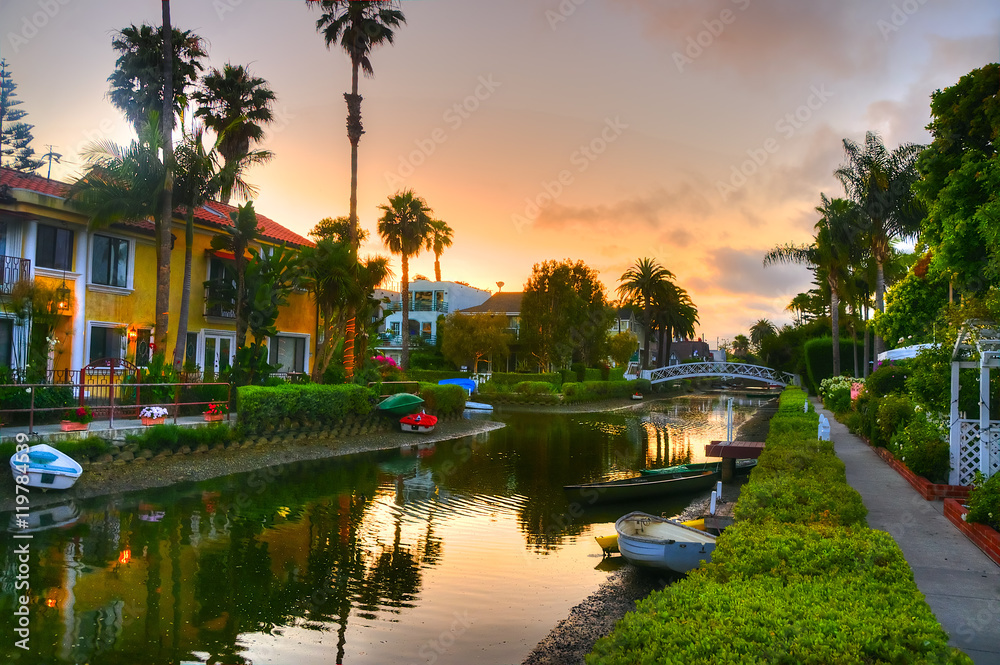
Canal-front homes sit directly on the water in the Venice Canal Historic District and are the rarest and most tightly regulated segment. Ownership here means a private dock or patio on the waterway, foot-bridge access, and a home that falls under both historic-district review and Coastal Commission jurisdiction. Because there are only a handful of these blocks, canal listings are thin and turn over slowly.
Walk-street bungalows are single-family homes on the pedestrian-only lanes where the "street" is a landscaped walkway rather than a road, with parking pushed to a rear alley or nearby. These homes skew smaller and older, many of them 1920s craftsman and cottage stock, and they trade a driveway for one of the quietest residential settings in coastal Los Angeles.
Lofts, both true industrial conversions and newer purpose-built units, cluster near Abbot Kinney Boulevard and the eastern edge of Venice. They appeal to buyers who want open floor plans, high ceilings, and a lock-and-leave lifestyle, and they typically come with less private outdoor space than a bungalow or canal home.
Single-family houses in the Silver Triangle and North Venice round out the menu, ranging from renovated period homes to ground-up modern architecture. This is where most of Venice's larger, family-scaled inventory lives, and where you'll see the widest price range in any given month.
If you're weighing Venice against the broader area, it helps to read up on what living in Venice is actually like day to day before you narrow to a single home type.
Comparing Venice's Residential Pockets: Canals, Silver Triangle, Walk Streets, and North Venice
Venice is best understood as a set of distinct residential pockets, each with its own character, price behavior, and buyer profile. The four that come up most often in a home search are the canal district, the Silver Triangle, the walk streets, and North Venice.
The Venice Canals are the signature pocket. The Venice Canal Historic District preserves six of the original canals, and the district was listed on the National Register of Historic Places in 1982, which is what puts the neighborhood's homes under historic review. The canals themselves were drained and renovated in 1992 and reopened in 1993 after decades of deterioration, which is why the waterways and walkways you tour today are in far better shape than their early-20th-century condition. Buyers here are paying for genuine scarcity and a car-free, water-facing setting, and they accept slower approvals in exchange.
The Silver Triangle sits between the canals, Washington Boulevard, and the Marina Del Rey edge, and it's where buyers who want a proper single-family house close to the water tend to concentrate. Lots are generally larger than on the walk streets, and the pocket draws people who want canal proximity without canal-specific restrictions.
The walk streets run through several parts of Venice and offer the most distinctive living experience after the canals: a home whose front door opens onto a planted pedestrian path with no cars. the practical trade-off is practical. You carry groceries from an alley or a nearby space, and renovation logistics are harder when a contractor can't pull a truck to the front door. Buyers who prioritize quiet and community over convenience gravitate here.
North Venice, the stretch closer to the Santa Monica border and Rose Avenue, blends single-family homes, duplexes, and newer construction, and it's often where buyers land when they want Venice character with a shorter reach into Santa Monica's amenities. It tends to offer more inventory turnover than the canals or walk streets simply because the housing stock is more varied.
Here is how the four pockets compare on the factors buyers ask about first:
Typical home type | Main draw | Key trade-off | |
|---|---|---|---|
Venice Canals | Canal-front houses | Water frontage, car-free, historic character | Historic-district and coastal review; thin inventory |
Silver Triangle | Single-family houses | Larger lots near the water | Higher entry price for detached homes |
Walk streets | Bungalows and cottages | Quiet, pedestrian-only setting | No front-door parking; harder renovation logistics |
North Venice | Mixed single-family and multi-unit | More turnover, closer to Santa Monica | Less of the singular Venice "character" pockets offer |
What Coastal-Zone and Historic-District Documents to Verify Before You Offer
Before you offer on any Venice home, verify three document sets: the property's coastal-zone status, its flood designation, and, if it's in the canal district, its historic-district obligations. Skipping any of these is the most common way a Venice purchase turns into a permitting headache after closing.
Coastal-zone status comes first because most of Venice sits inside California's coastal zone, which means a Coastal Development Permit may be required for additions, demolitions, and some remodels. The governing framework is the City of Los Angeles Venice Local Coastal Program and the Venice Coastal Specific Plan, which set height limits, density rules, and design standards that differ from standard LA zoning. If you plan to remodel or rebuild, confirm with the City of Los Angeles Planning Department exactly which permits your project would trigger before you commit, because the answer changes what your real total cost of ownership looks like.
Flood zone and elevation matter more in Venice than in most Westside neighborhoods, especially for canal-adjacent and low-lying lots. Pull the property's flood designation from the FEMA Flood Map Service Center, and if the home sits in a Special Flood Hazard Area, budget for flood insurance and ask for an elevation certificate. This single check can swing your annual carrying cost meaningfully, so do it during, not after, your due-diligence window.
Historic-district obligations apply specifically to homes in the Venice Canal Historic District. Because the district is on the National Register of Historic Places, exterior changes visible from the canals and walkways can face additional review, and the Venice Canals Association is a useful resource for understanding how the district is stewarded and what neighbors expect. If a canal home has been altered, confirm that prior work was permitted, because unpermitted changes become the buyer's problem after closing.
A practical rule for Venice: verify what you can build and insure before you fall in love with what you can see. For a broader checklist, it's worth reviewing the common mistakes buyers make in Venice so the coastal and historic pieces don't catch you late.
How Monica Antola Guides Venice Buyers Through Compass
Buyers working with Monica Antola of the Antola Coastal Group at Compass get a Venice search organized around the two things that decide these deals: matching the right pocket to how you actually want to live, and pressure-testing the coastal, flood, and historic documents before an offer goes out. The most useful early work in Venice is rarely the tour itself; it's confirming a specific home is buildable, insurable, and clear of permit surprises so you're not renegotiating after inspection.
Because Venice inventory is small and turns quickly, active MLS listings are only part of the picture. A meaningful share of Venice sales, particularly in the canals and on the walk streets, happen quietly before they hit the open market, so having a line into off-market and pre-market Venice listings often matters more than watching the public portals. If you're beginning a search, the buyer resources from the Antola Coastal Group lay out how the process works across Venice, Santa Monica, Marina Del Rey, and the wider Westside.
Compass gives the group access to real-time market information across those service areas, which is what makes a same-week comparison between, say, a North Venice townhome and a Marina Del Rey alternative practical rather than theoretical. The point of that reach is a cleaner decision, not a longer list.
Field Notes: How Venice Buyers Actually Compare Canal, Walk-Street, and Loft Living
When buyers narrow a Venice search, the decision almost always comes down to three living styles: canal, walk-street, and loft. Each answers a different question about how you want your days to feel, and understanding that is more useful than chasing price alone.
Buyers drawn to the canals are usually after a specific experience: water outside the door, foot-bridge walks, and a setting that feels nothing like the rest of Los Angeles. The honest trade-off is oversight and patience. Historic-district review and Coastal Development Permit requirements mean renovations take longer and cost more to get approved, and inventory is so limited that the right home may take a season or two to surface. Canal buyers who succeed tend to be flexible on timing and firm on location.
Buyers who choose a walk street are prioritizing quiet and neighborhood texture over convenience. The pedestrian setting is genuinely rare in coastal LA, but you should test-drive the practical parts before committing: where you'll park, how far you carry groceries, and whether future renovation access is workable given the lack of front-door vehicle access. Buyers who love walk streets almost never regret the quiet; the ones who struggle underestimated the logistics.
Buyers who land on a loft are usually optimizing for space, light, and low maintenance. Lofts near Abbot Kinney put you in the middle of Venice's dining and shopping without the upkeep of a house or a canal home's regulatory load. the practical trade-off is outdoor space and, sometimes, HOA rules that limit what you can change. This is the pocket to consider if a lock-and-leave lifestyle matters more than a private yard.
If your comparison also spans neighboring communities, it helps to weigh Venice against Santa Monica, Marina Del Rey, and Brentwood on commute, schools, and inventory depth at the same time you're comparing pockets within Venice. And if you're relocating rather than moving locally, reading up on what to know before moving to Venice will save you from surprises the listings don't show.
Work With Monica Antola in Venice
Monica Antola helps buyers and sellers weigh neighborhoods against commute, budget, and daily-routine fit. The service area covers Pacific Palisades, Malibu, Santa Monica, Brentwood, Venice, and Marina Del Rey, and the next conversation can turn school-boundary checks, HOA or metro-district tolerance, and current inventory into a shortlist worth touring.
Service areas: Pacific Palisades, Malibu, Santa Monica, Brentwood, Venice, Marina Del Rey, South Bay, and Westchester.
Office or service-area location: 839 Via De La Paz.
Phone: (310) 595-5181
Email: monica@antolaproperties.com
Contact: https://antolaproperties.com/contact
Related Reading
These nearby guides add useful context. For more detail, compare 12 Common Mistakes to Avoid When Buying a Home in Venice ca and notable Restaurants to try in Venice ca. Also worth a look: Modern Coastal Interior Design Trends in Venice and Things you Should Know About Moving to Venice ca.
Talk with our team
If you're weighing a specific Venice pocket, whether it's a canal home, a walk-street bungalow, or a loft near Abbot Kinney, send me the details through the contact form or call 310-595-5181, and I'll pull current active and off-market options in that band along with the coastal and flood notes for anything you're serious about. You can also email monica@antolaproperties.com with an address, and I'll send the permit and comp picture before you spend a Saturday touring a home that won't work.
Frequently Asked Questions
What types of homes are available in Venice, CA?
Venice offers a range of property types including single-family homes, canal-front cottages, converted live-work lofts, small multi-unit buildings, and newer architectural builds on walk streets. The neighborhood's lot sizes and zoning vary considerably by block, so the mix of what's actively listed at any given time shifts more than in more uniform neighborhoods. Buyers focused on a specific style, canals, walk streets, or standard lots near Abbot Kinney, should expect to filter carefully rather than assume inventory will be broad.
What is the difference between living on the Venice Canals versus a Venice walk street?
Canal homes sit directly on one of six navigable waterways and typically include private dock access, while walk streets are pedestrian-only corridors where motor vehicle access is from an alley at the rear. The canal lifestyle centers on water-facing outdoor space and a quieter, connected community feel; walk streets trade that water orientation for a more private, garden-focused front experience with foot-traffic neighbors rather than motorists. Both command meaningful premiums over standard Venice lots, but for different reasons, canal homes for the waterfront setting, walk streets for the unusual privacy they create in an otherwise dense urban neighborhood.
Do homes in the Venice Canals have historic-district restrictions?
The Venice Canals Historic District is listed on the National Register of Historic Places, which means alterations visible from the canal, façade changes, additions, dock modifications, can be subject to review under the City of Los Angeles's local historic preservation guidelines. Federal listing does not automatically restrict what a private owner can do, but projects requiring city permits may face additional scrutiny to ensure they don't compromise the district's historic character. Buyers planning significant renovations should confirm the scope of applicable review with a permit consultant or land-use attorney before closing, as the approval process can affect both timeline and design flexibility.
What should I verify about coastal permits before buying a home in Venice?
Venice falls within the California Coastal Zone, so construction, additions, and some exterior changes require a Coastal Development Permit from the California Coastal Commission in addition to standard city permits. The key thing to verify is whether any existing unpermitted work was done after the Coastal Act took effect, because unpermitted coastal-zone improvements can create compliance liability that transfers with the property. Reviewing permit history through the city's building and safety records, and confirming whether a prior CDP was issued for any non-original structures, should be part of due diligence on any Venice home.
How do I find off-market homes for sale in Venice, CA?
Off-market opportunities in Venice most often surface through agent-to-agent networks, Compass's internal pocket listing platform, and direct outreach to homeowners in target blocks, none of which appear on public MLS searches. Working with an agent who is active specifically in Venice and has relationships with other local agents increases exposure to those opportunities before they're formally listed. That said, off-market doesn't automatically mean better value; it means less competition, which benefits the buyer only if the pricing is still negotiated carefully.