
Verifying Fire Debris Clearance on a Pacific Palisades Lot: What 'Cleared' Actually Means (2026)
Antola Coastal Group works with buyers evaluating burned lots across Pacific Palisades, and the single most misunderstood word in these transactions is "cleared." Buying and rebuilding on fire-affected lots in Pacific Palisades starts with knowing exactly what a debris program removed, what it left behind, and which paperwork proves it. A lot that has been through the government cleanup is not automatically a lot you can pour a foundation on next month. The gap between "hazard removed" and "construction ready" is where budgets and timelines get blown, so this guide walks through how to verify each layer before you write an offer.
Short Answer
"Cleared" on a Pacific Palisades fire lot usually means the two-phase government debris program finished, not that the parcel is ready to build. The U.S. EPA completed Phase 1 household hazardous materials removal for the Palisades and Eaton fires, announced complete on February 26, 2025 (per epa.gov). The U.S. Army Corps of Engineers completed Phase 2 structural debris and ash removal for opt-in properties in September 2025 (per spl.usace.army.mil). Phase 2 scraped roughly six inches of soil from the ash footprint, but it did not remove pools, driveways, or intact hardscape, and foundation removal depended on the owner's Right of Entry election. To confirm status for a specific parcel, verify the property's completion sign-off through the LA County Recovers debris removal records (recovery.lacounty.gov) rather than relying on a listing description alone.
EPA Phase 1 vs USACE Phase 2: Two Different Things
Phase 1 and Phase 2 are separate operations run by separate federal agencies, and a lot needs both to be considered fully processed under the government program. Phase 1 was the U.S. EPA's household hazardous materials sweep, and the EPA announced it complete for the Eaton and Palisades fires on February 26, 2025, roughly in line with the 30-day timeline local officials requested (per epa.gov). This phase targeted the acutely dangerous material, not the bulk debris.
The scale of Phase 1 explains why it came first. Phase 1 crews numbering more than 1,700 staff removed over 1,000 lithium-ion batteries plus asbestos, compressed gas cylinders, household chemicals, and other hazardous materials (per epa.gov). Until those batteries and cylinders were gone, no bulk debris crew could safely work a parcel.
Phase 2 is the U.S. Army Corps of Engineers operation that most people picture when they say "cleared." The Corps handled structural ash, burned foundations where elected, contaminated soil, and hazard trees, and the U.S. Army Corps of Engineers completed Phase 2 for opt-in properties in September 2025 (per spl.usace.army.mil). Phase 1 is not Phase 2; unlike the hazardous-materials sweep, Phase 2 is the heavy debris and soil removal that leaves a scraped pad. A lot that finished Phase 1 but never opted into Phase 2 has only had its worst hazards pulled, not its structure hauled away. For a broader view of the process, our overview of buying fire-damaged lots in Pacific Palisades frames how these phases fit the purchase timeline.
What Phase 2 Did Not Remove (Pools, Driveways, Grading)
The government debris program left several site features in place that many buyers wrongly assume were part of the cleanup. Under the standard USACE Phase 2 scope, crews typically scraped roughly six inches of soil from the ash footprint (per recovery.lacounty.gov), but the program focused on fire debris and contaminated soil, not general site demolition. That distinction matters the moment you start pricing a rebuild.
Swimming pools are the clearest example. An intact in-ground pool shell was generally not demolished or filled by the Phase 2 program, which means a buyer inherits that removal or repair cost. Pool demolition, dewatering, and backfill on a Palisades hillside lot can run into five figures, and it is your line item, not the government's.
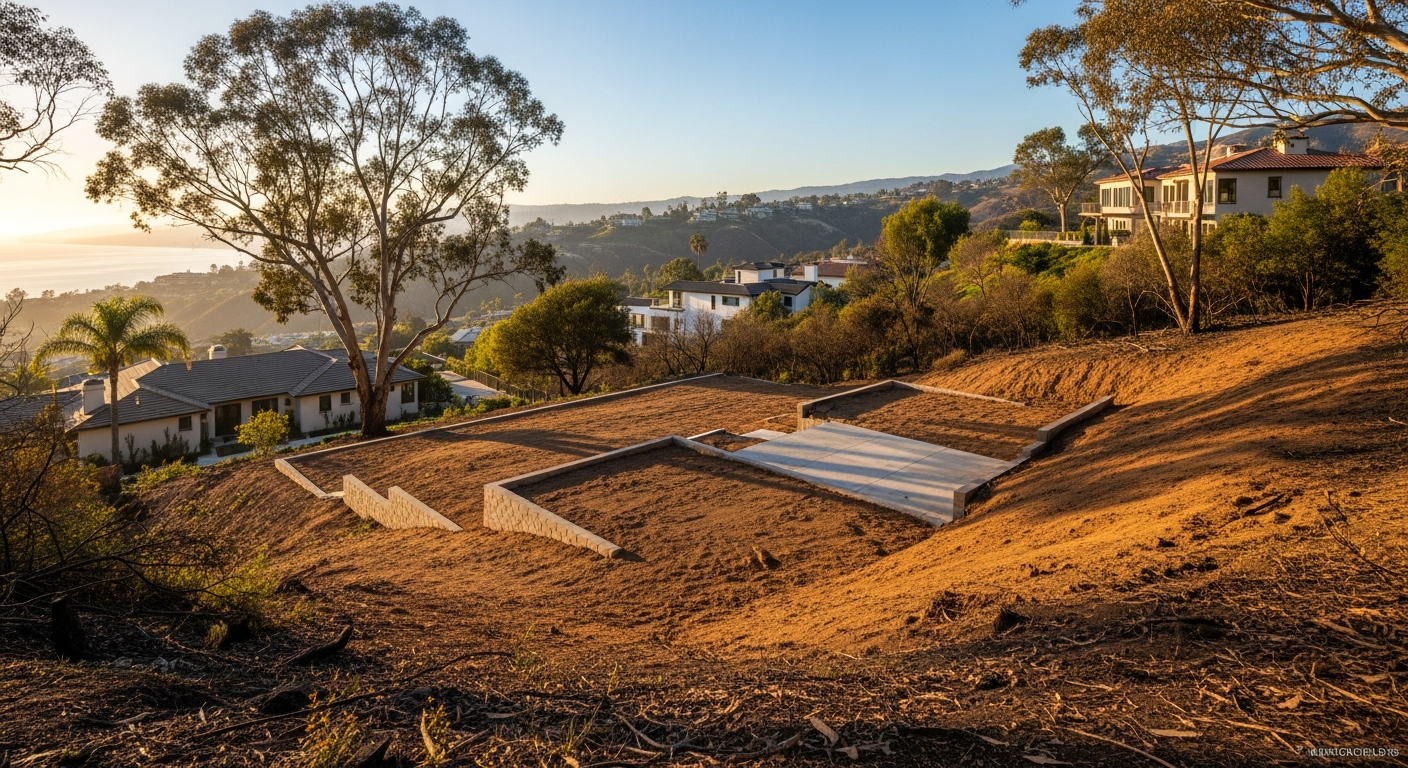
Driveways, flatwork, and hardscape outside the ash footprint were also generally left in place. A surviving concrete driveway apron or a stone retaining wall on a Marquez Knolls or Alphabet Streets lot may look like a bonus, but if your new design changes the footprint, that surviving hardscape becomes demolition you pay for. The verification step here is simple: walk the lot with your architect or builder and photograph every hard surface, then confirm against the completion documentation which features the program removed and which remain.
Final grading is the other gap. A scraped pad is not an engineered building pad. The six-inch scrape addressed contamination, not the cut-and-fill and compaction your structural plans will require, especially on the sloped parcels that define much of Pacific Palisades.
Foundation Removal and the Right of Entry Election
Whether the original foundation is still on the lot depends almost entirely on the Right of Entry election the previous owner made, so this is the first document to chase down. The Right of Entry, or ROE, is the signed authorization that let USACE crews enter private property to perform Phase 2 work. On the ROE form, owners elected whether to have the concrete foundation removed or to keep it, and that single checkbox governs what you find on site.
Owners who elected foundation removal generally have a fully scraped lot with no slab. Owners who elected to retain the foundation, often hoping to reuse it, left the slab in place, and that slab must be evaluated by a structural engineer before anyone assumes it is usable. A retained foundation that was exposed to intense fire is frequently not reusable, which turns an apparent head start into a demolition and disposal cost.
The government-sponsored USACE program is not the same as the local opt-out path. Property owners who opted out of the Corps program handled debris removal privately, hiring their own licensed contractors and coordinating their own permits and disposal manifests through LA County. A privately cleared lot can be perfectly clean, but the paper trail lives with the owner and their contractor, not with USACE, so you verify it differently. The LA County Right of Entry and opt-out program page (recovery.lacounty.gov/debris-removal-2/roe) is where the election categories are defined.
One planning note for anyone weighing a rebuild scope: an existing detached accessory structure, such as a garage, can be rebuilt and converted to an ADU under the city's recovery framework, and that existing envelope becomes the baseline you design from. Our guide to Pacific Palisades permits, timelines, and architects covers how those envelope rules interact with new plans.
Documents That Prove Clearance
A lot is only "cleared" if you can hold the documents that say so, and a listing agent's word is not one of them. For a parcel that went through the government program, request the USACE Phase 2 completion certificate or property completion notice, which confirms structural debris and soil removal finished and the site passed final inspection. This is the single document that most directly answers whether Phase 2 is done.
Pair that with the soil sampling and confirmation results. Under the program, confirmation soil samples were taken after the scrape to verify contamination levels met the clearance standard, and those lab results tell you whether additional remediation was flagged. A completion notice without passing soil results is an incomplete picture.
For a privately cleared, opt-out lot, the equivalent proof is the contractor's debris removal documentation and the disposal manifests showing where material went, plus any soil testing the owner commissioned. LA County coordinated these records, and the LA County Recovers debris removal pages (recovery.lacounty.gov) are the reference point for what a compliant private clearance looks like.
To check the debris clearance status of a specific parcel, start with the parcel's records through LA County Recovers rather than a portal listing. If you want the full inventory of active parcels, our Pacific Palisades lots for sale page tracks what is on the market.
Why Cleared Is Not Construction-Ready
A cleared lot is a lot with the fire debris removed; it is not a permitted, engineered, utility-served building site, and treating the two as equal is the most expensive mistake a buyer makes here. Clearance answers a hazard question. Construction readiness answers zoning, geotechnical, utility, and permitting questions that the debris program never touched.
Geotechnical work is the first hurdle on Pacific Palisades slopes. Engineering plans are required for any proposed structures on a hillside lot, and a geotechnical engineer may be required if the structural engineer determines that deeper footings are needed.
Geologically sensitive areas of the Palisades require geological and soil reports, and those areas do not qualify for the Self Certification program. A scraped pad tells you nothing about whether your footings need to go deeper.
Coastal and specific-plan rules add another layer for many parcels. Eligible rebuild projects both within and outside the Coastal Zone and Specific Plan Area are eligible for streamlining and are waived from CEQA, Specific Plan, and Coastal Act requirements, while non-eligible projects must comply with existing zoning. To see whether your parcel carries a coastal or canyon bluff flag, check the address in the city's Zone Information Map Access System, known as ZIMAS, under the Coastal Bluff Potential and Canyon Bluff Potential fields.
Utilities and permitting round out the gap. The rebuilding process runs through the City of Los Angeles One-Stop Rebuilding Center at 1828 Sawtelle Blvd. and the Palisades support center at 16925 Marquez Avenue, where LADBS, the Bureau of Engineering, LAFD, City Planning, and LADWP staff coordinate permits and infrastructure restoration. A serious buyer weighs the clearance status alongside these steps when Buying and rebuilding on fire-affected lots in Pacific Palisades, because a clean lot with an unresolved coastal flag or a deep-footing requirement carries a very different budget than a flat, streamlined parcel.
What To Verify Before Deciding
- Phase 1 status: Confirm EPA household hazardous materials removal was completed for the parcel; the EPA announced Palisades completion February 26, 2025 (per epa.gov).
- Phase 2 status: Confirm the USACE Phase 2 completion notice exists; the Corps finished opt-in properties in September 2025 (per spl.usace.army.mil).
- Program path: Determine whether the lot went through USACE opt-in or the private opt-out program, since that changes who holds the records (per recovery.lacounty.gov/debris-removal-2/roe).
- Foundation: Check the Right of Entry election to learn whether the slab was removed or retained, and have any retained foundation evaluated by a structural engineer.
- Site features: Walk the lot for pools, driveways, and hardscape the program did not remove, and price their demolition.
- Soil results: Request post-scrape confirmation soil sampling results, not just the completion notice.
- Geotech and coastal flags: Check ZIMAS for Coastal Bluff and Canyon Bluff Potential, and budget for a geological and soils report in sensitive areas.
Reviewed for freshness: July 2026.
Work With Monica Antola in Pacific Palisades
Monica Antola helps buyers compare homes and neighborhoods with a practical tour plan. The service area covers Pacific Palisades, Malibu, Santa Monica, Brentwood, Venice, and Marina del Rey, and the next conversation can turn commute pattern, neighborhood fit, HOA or metro-district tolerance, school-boundary checks, and current inventory into concrete next steps.
- Service areas: Pacific Palisades, Malibu, Santa Monica, Brentwood, Venice, Marina del Rey, Westchester, and the South Bay.
- Office: 2115 Main Street, Santa Monica, CA 90405.
- Phone: (310) 595-5181
- Email: monica@antolaproperties.com
Related Reading
These nearby guides add useful context. For more detail, see Custom Home Builder Pacific Palisades.
Frequently Asked Questions
How can I check the debris clearance status of a specific Pacific Palisades parcel?
Start with the official recovery tracking tools maintained by the county and the U.S. Army Corps of Engineers, which log parcel-level status by address or APN. Because status can change as work progresses, confirm the current record for the exact parcel before you make an offer or set a closing date.
Does 'cleared' mean the same thing as 'ready to build'?
No. 'Cleared' typically means debris has been removed and, in most cases, the parcel has passed a final soil sampling step. Being ready to build is a separate matter that depends on permits, geotechnical and soils reports, utility restoration, and current code compliance, all of which come after clearance.
Was the home's foundation removed during Phase 2 debris removal?
In many cases the Phase 2 program removed foundations when they were assessed as unstable or unsafe, but this was not automatic for every parcel. Whether a specific foundation was removed or left in place is recorded in the property's debris removal documentation, so review those records rather than assuming.
What did the debris removal program not cover, such as pools, driveways, or hardscape?
The government-sponsored program focused on structural debris, ash, contaminated soil, and hazardous materials, and it generally did not include items like swimming pools, driveways, flatwork, or other hardscape. That means budgeting for demolition or removal of those elements often falls to the owner. Confirm what was and was not addressed on the specific parcel before estimating site preparation costs.
What is the difference between the government-sponsored program and the local opt-out program?
The government-sponsored program handles debris removal at no direct out-of-pocket cost to the owner through the assigned contractors, following a standardized scope and process. The opt-out path means the owner arranges private, permitted debris removal at their own expense and must still meet the required documentation and soil testing standards. the practical trade-off is control and timing versus cost and coordination responsibility, and each parcel's chosen path affects what a buyer inherits.
From Monica's channel · November 2025 · 0:39
Road to Rebuild, Step 1: Is Your Lot Really Cleared?
Unless the owner opted in on the right-of-entry form, the Army Corps of Engineers may have left driveways and foundations outside the ash footprint untouched. Monica explains why that can delay permits and why a structural engineer may still need to check for fire damage or soil contamination.
Read the transcript
After a fire, it's not just about clearing debris. Unless you specifically requested it, the Army Corps of Engineers may have left hardscape elements like driveways or foundations untouched. These areas fall outside the ash footprint and aren't always cleared unless you opted in on your right of entry form.
And here's the catch. Skipping that step may delay your permits or compromise your build. Even if the site looks clean, you may need a structural engineer to inspect for fire damage or soil contamination.
Got questions about the rebuild process? Drop them in the comments or share this with someone who's just starting their road to rebuild.